



Understanding Calcium Deficiency in Indian Dogs

Calcium deficiency in home-fed Indian dogs stems primarily from home-cooked diets centered around rice, roti, cooked meats, or paneer, which fail to meet a dog's strict dietary calcium requirements. While cooking fresh food at home offers clear advantages over processed kibble, 94% of home-prepared dog diets are nutritionally incomplete, with 84% falling significantly short in calcium.
Unlike humans, adult dogs require a substantial, highly concentrated intake of daily calcium to support skeletal strength, nerve transmission, and muscle contraction. Meat, grains, and vegetables do not contain enough natural calcium to meet these physiological baseline needs. Over time, feeding an unsupplemented home diet forces the dog's body to draw calcium out of its own bones to keep blood levels steady, leading to progressive bone density loss without obvious early symptoms.
Addressing this gap requires understanding why typical Indian kitchen staples fall short, how calcium balances with phosphorus, and how to deliver precise, measurable supplementation every day.
The Hidden Calcium Gap in Home-Cooked Indian Diets
The dietary gap between what a dog needs and what home food delivers is substantial. According to National Research Council (NRC) standards, a medium adult dog weighing 15 kg requires a Recommended Allowance of 750 mg of elemental calcium per day.
A standard home-cooked meal consisting of boiled chicken, rice, and vegetables provides only about 62 mg of calcium daily. This creates a severe daily deficit of 688 mg. Many pet parents attempt to close this gap by adding a daily boiled egg, assuming it acts as a complete natural multivitamin. However, one boiled egg adds only about 27 mg of calcium, leaving a 15 kg dog roughly 660 mg short of its daily requirement.
| Nutrient Factor | Daily Requirement (15 kg Dog) | Provided by Typical Home Diet | Gap | Added by 1 Boiled Egg | Remaining Gap |
|---|---|---|---|---|---|
| Calcium | 750 mg | ~62 mg | −688 mg | ~27 mg | −661 mg |
Dairy products like curd or cottage cheese (paneer) are also commonly used, but they present two challenges: they are often poorly tolerated by adult dogs with mild lactose sensitivity, and the volume required to deliver 750 mg of calcium would introduce excessive fat and protein into the daily diet.
The Calcium-to-Phosphorus Inversion and Its Risks
Calcium cannot be evaluated in isolation. In canine nutrition, calcium must exist in a balanced relationship with phosphorus, ideally maintained at a ratio between 1:1 and 1.4:1.
Home-cooked meals heavily reliant on unsupplemented muscle meat severely disrupt this ratio. Plain chicken breast, for instance, contains high amounts of phosphorus but very little calcium, yielding an inverted calcium-to-phosphorus ratio of roughly 1:16.
```
Required Ratio: Calcium [1.0 to 1.4] : [1.0] Phosphorus
Chicken Breast: Calcium [1.0] : [16.0] Phosphorus (Inverted)
```
When a dog consumes excess phosphorus relative to calcium over months or years, the parathyroid glands release hormone signals to pull calcium directly from the skeletal frame to stabilize blood plasma levels. This physiological mechanism, known as nutritional secondary hyperparathyroidism, gradually softens bone tissue. Affected dogs may experience joint discomfort, increased susceptibility to fractures, and loose teeth long before systemic weakness becomes obvious on clinical exams.
Safe Calcium Supplementation: Daily Complete's Precise Formula
Correcting a calcium deficit requires exact measurement. Indiscriminate dosing with human bone-meal or unmeasured calcium powders carries risks, as excess calcium can interfere with the absorption of other minerals like zinc and iron.
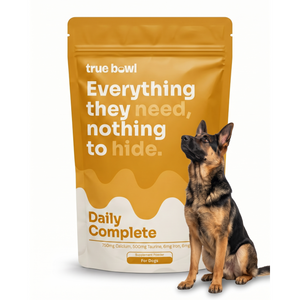
True Bowl Daily Complete is formulated as an unflavoured nutritional powder designed to mix directly into home-prepared food. Rather than relying on approximate estimates, each 5 g scoop delivers exactly 750 mg of elemental calcium, matching the exact NRC Recommended Allowance for a 15 kg adult dog.
To ensure the mineral is absorbed and used effectively without disrupting existing dietary balances, the formula integrates key supporting nutrients:
- Vitamin D3 (112 IU per 5 g scoop): Facilitates active calcium absorption across the intestinal wall.
- Minimal Phosphorus (16 mcg per 5 g scoop): Formulated deliberately low, knowing home diets already over-deliver phosphorus, thereby restoring the target 1:1 to 1.4:1 calcium-to-phosphorus ratio.
- Trace Minerals: Includes balanced levels of zinc (6 mg) and iron (6 mg) to prevent competitive mineral displacement.
Daily Complete uses a clean, scoop-based protocol tailored to body weight:
- Under 10 kg: ½ scoop (2.5 g powder)
- 10–20 kg: 1 scoop (5 g powder, providing 750 mg calcium)
- 20–30 kg: 2 scoops (10 g powder)
- Over 30 kg: 3 scoops (15 g powder)
Every batch is independently tested to ensure label accuracy, with certificates published directly on The Proof.
Critical Safety Restriction: Puppies
Calcium supplementation must be strictly avoided in growing puppies. Puppies under 12 months (and large or giant breed puppies under 18 months, such as Labradors, German Shepherds, and Golden Retrievers) cannot regulate intestinal calcium absorption efficiently. Excess calcium during their rapid growth phase causes abnormal bone mineralization and severe skeletal deformities. Daily Complete is formulated exclusively for adult dogs aged 12 months and older (18 months for large breeds).
FAQ
Can I give my dog cow's milk or curd to supply daily calcium?
No. Milk and curd do not supply enough calcium to meet an adult dog's daily baseline requirement, and large amounts can cause digestive distress due to lactose. A standard serving of curd provides only a fraction of the necessary multi-hundred-milligram daily intake.
What are the early physical signs of calcium deficiency in dogs?
Early calcium deficiency is often invisible because the body leaches calcium from bones to keep blood levels normal. Over time, signs include shifting leg lameness, joint stiffness, lethargy, muscle tremors, and dental issues such as weak enamel or loose teeth.
Is Daily Complete safe for dogs with kidney disease?
Dogs with diagnosed kidney disease require strict medical management of phosphorus and mineral intake. You should not start Daily Complete or any nutritional supplement for a dog with renal disease without explicit guidance from your veterinarian.