



When temperatures drop during Indian winters, many pet parents notice their dogs moving more slowly in the morning. A dog that usually leaps out of bed might hesitate before standing up, take shorter strides on walks, or hesitate before climbing stairs.
Winter joint stiffness is driven by specific physiological changes: lower ambient temperatures increase the viscosity of synovial fluid—the shock absorber inside joint capsules—and reduce peripheral blood flow to surrounding muscles and tendons. On cold tile or marble floors common in Indian homes, uninsulated joint tissue chills quickly, creating stiffness and discomfort.
Managing seasonal stiffness requires active nutritional support delivered at therapeutic doses that support cartilage structure and maintain joint lubrication year-round.
Why Cold Weather Exacerbates Joint Stiffness

Joints rely on synovial fluid to reduce friction between articular cartilage surfaces. In warmer weather, this fluid stays thin, allowing smooth movement. When temperatures drop, synovial fluid thickens, creating mechanical resistance when the joint first moves after rest.
Cold weather also causes peripheral blood vessels to constrict to conserve core body heat. Reduced circulation to extremities leaves surrounding muscles and tendons tight.
In urban Indian homes, these physiological responses are multiplied by environmental factors:
- Cold flooring: Bare tile, marble, and granite floors pull heat from a resting dog's body, chilling joint structures directly.
- Inactivity: Shorter winter walks reduce overall circulation, preventing joint fluid from warming naturally.
- Micro-trauma recovery: Dogs with underlying structural cartilage wear feel atmospheric pressure drops more acutely.
The Gap in Standard Joint Supplements: Decorative Micro-Dosing
When searching for joint support during winter, pet parents often find chews or treats claiming to support joint health. However, a major issue in the pet supplement industry is "decorative micro-dosing"—listing beneficial ingredients on the front of the label while providing only trace amounts inside the product.
Glucosamine and chondroitin require specific, weight-based quantities to maintain cartilage effectively. A few milligrams hidden inside a proprietary blend cannot achieve therapeutic benefit. Without exact milligram amounts declared per serving, pet parents cannot verify if a product meets their dog's physiological needs.
At True Bowl, we publish every ingredient quantity openly on our labels. You can view our verified third-party laboratory testing on The Proof.
The 3-Mechanism Approach to Mobility Support
Effective joint support addresses three distinct structural and physiological requirements simultaneously: building cartilage matrix, managing joint inflammation, and maintaining fluid lubrication. Addressing only one pathway leaves joint tissue vulnerable.
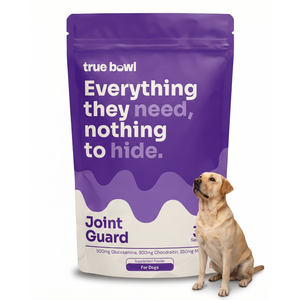
True Bowl Joint Guard combines 9 active ingredients across these core mechanisms:
1. Structural Repair & Cartilage Maintenance
Cartilage naturally wears down under kinetic stress. Rebuilding and protecting the matrix requires targeted building blocks:
- Glucosamine HCl (500 mg per scoop): An essential precursor for glycosaminoglycans, supporting cartilage structure.
- Chondroitin Sulphate (300 mg per scoop): Helps retain water within cartilage to maintain elasticity and shock absorption.
- Collagen Peptide Type II (50 mg per scoop): Formulated to support the primary structural protein found in joint cartilage.
- Manganese Proteinate 10% (10 mg per scoop): An essential trace mineral cofactor required for collagen synthesis.
2. Multi-Pathway Inflammation Management
Seasonal stiffness often involves mild tissue irritation. Using multiple complementary anti-inflammatory pathways avoids over-reliance on a single mechanism:
- MSM / Methylsulfonylmethane (350 mg per scoop): Suppresses NF-kB inflammatory pathways and supplies bioavailable sulphur for connective tissue repair.
- Boswellia Serrata (150 mg per scoop): Inhibits the 5-LOX inflammatory enzyme pathway.
- Curcumin 95% + Piperine (60 mg per scoop): Targets the COX-2 enzyme pathway. Standard turmeric powder contains only about 3% curcumin; Joint Guard uses a 95% extract paired with piperine to ensure absorption.
- Green-Lipped Mussel (400 mg per scoop): Contains eicosatetraenoic acid (ETA), a unique omega-3 fatty acid acting specifically on joint tissue.
3. Joint Lubrication
- Sodium Hyaluronate (45 mg per scoop): Directly supports synovial fluid viscosity and cushioning between joint surfaces.
| Active Ingredient | True Bowl Joint Guard (per 5 g scoop) | Typical Market Products | Primary Focus |
|---|---|---|---|
| Glucosamine HCl | 500 mg | Undisclosed / trace | Structural cartilage support |
| Chondroitin Sulphate | 300 mg | Undisclosed / trace | Cartilage elasticity & water retention |
| Green-Lipped Mussel | 400 mg | Not present / trace | Joint-specific omega-3 (ETA) |
| MSM | 350 mg | Undisclosed / trace | Connective tissue & NF-kB pathway |
| Boswellia Serrata | 150 mg | Rarely present | 5-LOX anti-inflammatory pathway |
| Curcumin 95% + Piperine | 60 mg | Unstandardized powder | COX-2 anti-inflammatory pathway |
| Collagen Peptide Type II | 50 mg | Rarely present | Structural protein support |
| Sodium Hyaluronate | 45 mg | Rarely present | Synovial fluid lubrication |
| Manganese Proteinate (10%) | 10 mg | Not present | Collagen synthesis cofactor |
Simple Dosing Protocol
Joint Guard is a daily powder designed to be mixed directly into your dog's regular food once per day. Active ingredient delivery scales proportionally with your dog's weight using our standard 5 g scoop:
| Dog Weight | Daily Serving | Powder Weight | Glucosamine HCl Delivered |
|---|---|---|---|
| Less than 10 kg | ½ scoop | 2.5 g | 250 mg |
| 10–20 kg | 1 scoop | 5 g | 500 mg |
| 20–30 kg | 2 scoops | 10 g | 1,000 mg |
| More than 30 kg | 3 scoops | 15 g | 1,500 mg |
Starting Joint Support Before Stiffness Begins
Waiting until a dog shows a severe limp or refusal to walk means cartilage wear is already well underway. Global veterinary standard practice emphasizes preventive supplementation starting from 12 months of age, particularly for large and giant breeds predisposed to joint challenges.
Breeds benefiting from early preventive joint support starting at 12 months include:
- Labrador Retrievers
- Golden Retrievers
- German Shepherds
- Rottweilers
- Great Danes
By maintaining joint fluid viscosity and supporting cartilage integrity daily, you can help your dog maintain comfortable mobility through cold winters and throughout their life.
FAQ
Why does my dog limp only in the morning during winter?
Morning stiffness occurs because synovial fluid cools and thickens while your dog rests undisturbed overnight. Additionally, body temperature and peripheral circulation drop during sleep. As your dog moves, blood circulation increases and joint fluid warms up, easing movement after 10–15 minutes.
How long does it take to see mobility support from a daily supplement?
Joint nutraceuticals work through cumulative tissue integration rather than immediate chemical sedation. Structural ingredients like glucosamine, chondroitin, and collagen build up in cartilage tissue over 4 to 6 weeks of continuous daily feeding.
Can I give Joint Guard to a puppy under 12 months old?
Joint Guard is formulated for adult dogs aged 12 months and older. Growing puppies require specific calcium-to-phosphorus ratios managed through proper baseline puppy nutrition, making structural joint supplementation unnecessary unless specifically directed by your veterinarian.