



When a senior dog slows down, pet parents often assume it is simply an inevitable part of getting older. In reality, subtle behavioral shifts are frequently early signals of joint discomfort rather than general fatigue. Dogs instinctively mask physical discomfort, meaning stiffness or stair hesitation rarely presents as obvious limping until joint cartilage has already experienced wear.
Mobility changes in dogs are mechanical: as cartilage wears down and joint fluid thins, friction causes mild inflammation and stiffness after rest. Catching these early signals allows pet parents to support joint function before stiffness restricts daily movement.
Distinguishing age-related energy drops from joint discomfort is the first step toward maintaining your dog's strength, comfort, and mobility through their senior years.
5 Subtle Signs Your Senior Dog is Experiencing Joint Discomfort

While overt limping is easy to spot, early joint discomfort presents through quiet changes in routine, posture, and movement.
1. Stiffness After Resting
If your dog takes several seconds to stand up after a nap and moves stiffly before "warming up," this indicates joint friction. As a dog rests, synovial fluid inside the joint capsule settles; movement is required to re-lubricate the joint articulation.
2. Hesitating Before Stairs, Cars, or Furniture
Pausing at a staircase, measuring a jump into an SUV, or hesitating before hopping onto a sofa indicates that loading weight onto hind or front limbs causes discomfort.
3. Changes in Posture and Weight Distribution
Dogs experiencing hip or knee discomfort shift weight forward onto their front legs, leading to muscle loss over the hindquarters. Conversely, elbow stiffness causes dogs to sit back awkwardly. Smooth tiled flooring common in Indian homes often accentuates this instability.
4. Licking or Chewing at Specific Joints
Dogs frequently groom areas that ache. Persistent licking around the wrists (carpi), elbows, or hocks can stain fur and signals localized discomfort in the underlying joint structure.
5. Irritability or Restlessness
A once-placid dog growling when touched near the lower back or hips is communicating physical discomfort. Nighttime restlessness also occurs as finding a comfortable sleeping position becomes difficult on stiff joints.
Normal Aging vs. Joint Discomfort: How to Tell
It is important to distinguish general senior slowdown from joint-specific issues.
- Normal aging: Your dog sleeps slightly more and plays with less intensity, but still rises easily and moves fluidly when excited.
- Joint discomfort: Your dog remains mentally alert and eager for walks, but struggles to rise, walks stiffly, or avoids stairs and slippery floors.
Certain breeds carry a higher genetic predisposition for joint issues:
| Breed | Lifetime Joint Risk | Recommended Start Age | Key Concern |
|---|---|---|---|
| German Shepherd | 70–80% | 12 months | Hip dysplasia, spinal stiffness |
| Labrador Retriever | 60–80% | 12 months | Hip & elbow dysplasia, cruciate stress |
| Golden Retriever | 60–70% | 12 months | Hip dysplasia, middle-age joint stiffness |
| Rottweiler | 60–70% | 12–18 months | Early-onset hip & elbow dysplasia |
| Indie / Mixed Breed | 15–25% | 2–3 years (earlier if overweight) | General wear, lower genetic predisposition |
Global veterinary standards recommend starting preventive joint support as early as 12 months for high-risk large breeds, rather than waiting for joint wear to manifest.
Why Early Support Requires Full, Effective Dosages
When supporting joint cartilage and fluid, exact dosage matters. Effective joint maintenance requires targeting three distinct physiological mechanisms simultaneously:
- Structural cartilage support: Providing metabolic building blocks to maintain cartilage density.
- Multi-pathway anti-inflammation: Targeting distinct inflammatory pathways (such as NF-kB, 5-LOX, and COX-2) rather than relying on a single ingredient.
- Synovial fluid lubrication: Maintaining viscous joint fluid to reduce mechanical friction.
Raw home remedies like turmeric powder contain only about 3% curcumin by weight, which the canine gastrointestinal tract excretes unabsorbed unless paired with standardizing compounds like piperine.
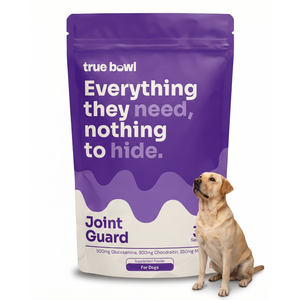
True Bowl Joint Guard is an unflavoured daily powder mixed directly into fresh meals, delivering 9 active ingredients at fully disclosed, clinically meaningful quantities per scoop.
Joint Guard Active Ingredients Per Single Scoop (5 g for 10–20 kg Dog)
| Active Ingredient | Exact Dosage (1 Scoop) | Physiological Role & Mechanism |
|---|---|---|
| Glucosamine HCl | 500 mg | Primary structural building block for cartilage maintenance |
| Green-Lipped Mussel | 400 mg | Contains ETA omega-3 fatty acids targeting joint tissue |
| MSM (Methylsulfonylmethane) | 350 mg | Organic sulfur targeting the NF-kB anti-inflammatory pathway |
| Chondroitin Sulphate | 300 mg | Helps maintain cartilage elasticity and hydration |
| Boswellia Serrata | 150 mg | Herbal extract targeting the 5-LOX inflammatory enzyme |
| Curcumin 95% + Piperine | 60 mg | Bioavailable antioxidant targeting the COX-2 pathway |
| Collagen Peptide Type II | 50 mg | Structural framework for articular joint cartilage |
| Sodium Hyaluronate | 45 mg | Replenishes synovial fluid for joint lubrication |
| Manganese Proteinate (10%) | 10 mg | Essential mineral cofactor required for collagen synthesis |
Dosing scales cleanly by dog weight using the included scoop:
- Under 10 kg: ½ scoop (2.5 g daily)
- 10–20 kg: 1 scoop (5 g daily)
- 20–30 kg: 2 scoops (10 g daily)
- Over 30 kg: 3 scoops (15 g daily)
You can verify third-party laboratory testing for purity and active levels anytime on The Proof.
Daily Steps to Keep Your Senior Dog Moving Comfortably
In addition to targeted joint nutraceuticals, simple environmental adjustments improve daily comfort for a senior dog:
- Lay non-slip runners: Yoga mats or runners over slick tile or marble flooring prevent slipping and reduce joint strain.
- Maintain optimal body weight: Excess weight increases mechanical load on hip and knee joints. Keeping your senior dog lean provides essential physical protection.
- Switch to gentle, consistent exercise: Replace high-impact fetch with shorter, controlled leash walks on soft ground or grass.
FAQ
How can I tell if my senior dog is slowing down from joint discomfort or just normal aging?
Dogs slowing down from normal aging maintain fluid, easy movements despite lower overall stamina. Dogs experiencing joint discomfort show movement-specific stiffness, particularly when rising after rest, hesitation before climbing stairs, and weight-shifting off affected limbs.
When should I start joint supplements for my dog?
For large breeds with high genetic joint risk (such as Labradors, Golden Retrievers, and German Shepherds), veterinary guidelines recommend initiating preventive joint support as early as 12 months of age. For Indies and smaller breeds, preventive joint care is typically introduced around 2 to 3 years of age or at the first sign of mobility hesitation.
Can joint supplements replace veterinary care for diagnosed joint conditions?
Dietary supplements are not medicines and do not replace veterinary care for diagnosed joint conditions. Joint Guard is a preventive nutraceutical formulated to support joint structure, maintain synovial fluid viscosity, and promote daily mobility when used consistently alongside proper weight management and controlled exercise. Always consult a veterinarian for diagnosed medical conditions.