




Why the Calcium Phosphorus Ratio Matters for Dogs

Dogs require a strict calcium-to-phosphorus ratio between 1:1 and 1.4:1 to build and maintain healthy bones, support nerve transmission, and manage muscle contractions. When this balance is altered—as routinely occurs with home-cooked Indian meals composed primarily of unsupplemented meat, rice, and roti—a dog's body compensates by leaching calcium directly from its skeletal structure to maintain tight blood calcium levels.
While home-cooked food is prepared with care, research indicates that 94% of home-prepared dog diets are nutritionally incomplete, with calcium being deficient in 84% of diets. Feeding plain meat creates a severe imbalance known as a calcium-to-phosphorus (Ca:P) inversion. For instance, chicken breast has a Ca:P ratio of approximately 1:16, delivering excessive phosphorus relative to calcium.
Over time, prolonged calcium deficiency combined with high dietary phosphorus triggers a physiological state called nutritional secondary hyperparathyroidism. Because the body must prioritize blood calcium levels for heart and muscular function, the parathyroid gland secretes hormones that force the skeleton to break down bone tissue to release calcium into the bloodstream. This weakens structural integrity and compromises joint health from within.
The Mineral Gap in Home-Cooked Indian Diets
Pet parents often attempt to address mineral shortfalls by adding common household items like boiled eggs, curd, or paneer to their dog's bowl. However, food additions alone rarely close the mathematical gap. A single boiled egg contributes roughly 27 mg of calcium—a fraction of what a medium-sized dog needs every day.
| Diet Element / Nutrient | NRC Requirement (15 kg dog) | Typical Indian Home Diet | Resulting Daily Gap |
|---|---|---|---|
| Calcium | 750 mg | ~62 mg | −688 mg |
| Calcium-to-Phosphorus Ratio | 1:1 to 1.4:1 | ~1:16 (in unsupplemented meat) | Inverted mineral balance |
| Boiled Egg Addition | +27 mg calcium per egg | Leaves ~660 mg gap | Insufficient mineral recovery |
Because home diets made of grains and meat already over-deliver phosphorus, introducing a standard multi-mineral product that contains both calcium and phosphorus can actually perpetuate the ratio inversion. Effective dietary correction requires adding elemental calcium while keeping added phosphorus minimal.
How Daily Complete Rebalances Mineral Nutrition
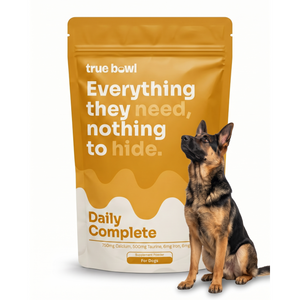
Restoring a healthy mineral balance requires precision rather than guesswork. True Bowl formulated Daily Complete as a daily powder delivering 750 mg of calcium per 5 g scoop while restricting phosphorus to just 16 mcg.
By delivering clean calcium without extra phosphorus, the formula directly lifts dietary calcium to offset the high phosphorus levels naturally present in rice, roti, and meat meals. Feed Honestly. — everything they need, nothing to hide.
| Dog Weight | Daily Complete Dose | Daily Powder Weight |
|---|---|---|
| Less than 10 kg | ½ scoop | 2.5 g |
| 10–20 kg | 1 scoop | 5 g |
| 20–30 kg | 2 scoops | 10 g |
| More than 30 kg | 3 scoops | 15 g |
Administered once daily mixed into warm food, this scoop protocol provides verified mineral support calibrated to your dog's exact body weight.
Life Stage Safety Guidelines
Calcium supplementation must be handled responsibly based on age, breed, and health status:
Puppies Under 12 Months
Puppies under 12 months (and large or giant breed puppies under 18 months, such as Labradors, German Shepherds, and Rottweilers) must not be given Daily Complete or additional calcium supplements. During rapid growth phases, excess calcium cannot be regulated efficiently by young dogs, leading to severe bone deformities and joint malformation.
Dogs with Renal Conditions
Dogs diagnosed with kidney or renal disease require individualized phosphorus and calcium intake managed directly by a veterinary specialist. Do not introduce mineral supplements to dogs with kidney disease without direct vet consultation.
FAQ
What is the ideal calcium-to-phosphorus ratio for dogs?
The ideal calcium-to-phosphorus ratio for dogs is between 1:1 and 1.4:1. Maintaining this target range prevents the body from drawing calcium out of skeletal tissue to balance blood mineral concentrations.
Can I balance my dog's calcium intake by adding milk or curd?
Dairy products like milk and curd contain modest amounts of calcium, but they also carry high levels of phosphorus and lactose. They cannot reliably correct a 688 mg calcium deficit and can cause gastrointestinal distress in lactose-sensitive dogs.
Why does Daily Complete contain so little phosphorus?
Indian home diets based on meat, wheat, and rice already supply more than enough phosphorus. Daily Complete deliberately limits phosphorus to 16 mcg per 5 g scoop so that adding 750 mg of calcium corrects the ratio without overloading total phosphorus.
Related reading
- What Is Rubber Jaw Syndrome in Dogs? Causes and Prevention
- Calcium Deficiency in Indian Dogs: Causes, Risks, and Solutions