



Why Preventive Joint Care for Labradors Starts at 12 Months

You should start a joint supplement for a Labrador Retriever at 12 months of age, as soon as their skeletal growth plates close. Labradors carry a 60–80% lifetime risk of joint challenges, primarily due to genetic predispositions like hip dysplasia, elbow dysplasia, and cruciate ligament tears. Waiting for visible signs—such as stiffness after rest, hesitation before jumping, or slowing down on walks—means joint cartilage has already suffered structural wear.
Cartilage is avascular tissue, meaning it lacks a direct blood supply. When cartilage degrades, the body cannot easily or quickly rebuild it. Preventive joint supplementation introduces structural precursors and anti-inflammatory compounds while joint tissue is still intact, helping to maintain normal synovial fluid viscosity and cartilage density before daily friction causes mechanical wear.
In urban Indian homes, hard tile and marble flooring present an ongoing environmental challenge for heavy-set breeds. Slipping on smooth surfaces subjects a Labrador’s hips and stifles to subtle lateral stress. Proactive supplementation starting at 12 months gives your dog the nutritional backing needed to absorb routine impact as they transition into full adult activity.
The Biology Behind the Labrador Joint Predisposition
Labradors are heavy-boned, high-energy working dogs engineered for endurance. However, their rapid growth rate during puppyhood combined with inherited skeletal geometry makes them particularly vulnerable to joint incongruity.
Genetic Risk Factors
Hip dysplasia occurs when the head of the femur does not fit seamlessly into the pelvic socket. Instead of smooth articulation, the bones grind loosely against each other during motion. Over time, this mechanical instability degrades articular cartilage and alters normal joint mechanics. Because Labradors rank among the breeds most frequently affected by hip and elbow dysplasia, veterinary consensus has shifted away from reactive management toward early, preventive joint support starting at physical maturity.
Indoor Surfaces in Indian Homes
Unlike natural turf or soil, indoor flooring materials like marble, granite, and polished vitrified tiles offer minimal traction. Every time a 30 kg Labrador pushes off a slippery floor to stand, run, or greet you at the door, micro-slippage occurs. This puts extra strain on joint capsules and surrounding ligaments. Early supplementation helps support joint fluid cushioning to mitigate this continuous mechanical shock.
What to Look for in a Labrador Joint Formula
Many standard commercial joint products contain only two active ingredients—typically glucosamine and chondroitin—and often hide their actual levels behind unstated "proprietary blends." Comprehensive preventive care requires a multi-pathway approach addressable across three distinct mechanisms: structural repair, anti-inflammation, and joint lubrication.
The 3 Mechanisms of Complete Joint Support
- Structural integrity: Glucosamine HCl, Chondroitin Sulphate, Collagen Peptide Type II, and Manganese Proteinate (10%) supply essential glycosaminoglycan building blocks needed to synthesize and maintain healthy cartilage matrix.
- Targeted anti-inflammation: Joint stress activates multiple inflammatory cascades. Combining Methylsulfonylmethane (MSM), Boswellia Serrata, Curcumin 95% + Piperine, and Green-Lipped Mussel addresses distinct pathways simultaneously—MSM acts on NF-kB, curcumin targets COX-2, boswellia inhibits 5-LOX, and green-lipped mussel supplies ETA.
- Joint lubrication: Sodium Hyaluronate (hyaluronic acid) supports the thickness and shock-absorbing capacity of synovial fluid, reducing friction inside the joint capsule.
Why Active Concentration Matters
Raw turmeric powder contains only about 3% active curcumin, which the canine gastrointestinal tract absorbs poorly on its own. Using a concentrated Curcumin 95% extract combined with Piperine ensures the active compound enters circulation. Similarly, Green-Lipped Mussel delivers eicosatetraenoic acid (ETA), a specialized omega-3 fatty acid found almost exclusively in green-lipped mussels that acts specifically on joint tissue.
Dosing Joint Support by Labrador Body Weight
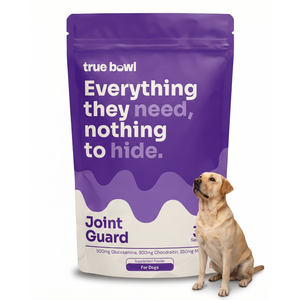
Because joint support requires weight-appropriate active amounts, doses must scale with body mass. True Bowl Joint Guard is an unflavoured powder designed for daily mixing into food, formulated with 9 active ingredients to provide clear, disclosed amounts per 5 g scoop.
Joint Guard Daily Dosing Guidelines
| Dog Weight | Daily Scoop Dose | Glucosamine HCl | Green-Lipped Mussel | MSM | Chondroitin Sulphate |
|---|---|---|---|---|---|
| 10–20 kg | 1 scoop | 500 mg | 400 mg | 350 mg | 300 mg |
| 20–30 kg | 2 scoops | 1,000 mg | 800 mg | 700 mg | 600 mg |
| More than 30 kg | 3 scoops | 1,500 mg | 1,200 mg | 1,050 mg | 900 mg |
Every 5 g scoop of Joint Guard also provides 150 mg Boswellia Serrata, 60 mg Curcumin 95% + Piperine, 50 mg Collagen Peptide Type II, 45 mg Sodium Hyaluronate, and 10 mg Manganese Proteinate (10%). Most adult Labradors fall into the 20–30 kg or >30 kg weight bands, requiring 2 to 3 scoops daily mixed directly into their regular meal.
(Note: Glucosamine HCl in Joint Guard is derived from shellfish. If your dog has a known shellfish allergy, consult your veterinarian before use.)
FAQ
Can I give joint supplements to a Labrador puppy under 12 months?
No. Puppies under 12 months are still undergoing rapid bone development, and their skeletal growth plates remain open. Preventive joint supplements are unnecessary before 12 months and can obscure early developmental abnormalities that require direct veterinary evaluation. Focus on balanced puppy nutrition and introduce joint support at 12 months once physical growth stabilizes.
Should I wait until my Labrador shows signs of limping before starting?
No. Limping, difficulty rising, or reluctance to climb stairs indicates that joint tissue wear and inflammation are already established. Because cartilage lacks a direct blood supply, repairing damaged joint matrix is difficult. Starting supplementation at 12 months helps maintain healthy cartilage and synovial fluid before visible mobility loss occurs.
How do I feed Joint Guard to my Labrador?
Joint Guard is a loose powder that you mix directly into your dog's daily meal once per day. Measure the correct scoop amount based on your Labrador's current weight using the provided scoop. Feeding Honestly means never hiding active dosages behind proprietary blends—every scoop delivers explicit amounts backed by clinical formulation principles.
Related reading
- Joint Supplements for Indian Dogs: Dosages, Flooring, and Real Prevention
- Senior Dog Slowing Down? 5 Subtle Signs It's Joint Discomfort (Not Just Old Age)