



Most home-cooked dog food in India fails to provide complete daily nutrition, with research showing that over 94% of home-prepared pet diets are nutritionally incomplete against National Research Council (NRC) standards. While preparing fresh meals from chicken, rice, paneer, and vegetables comes from a place of care, canine metabolic requirements differ fundamentally from human dietary needs.
A bowl of fresh home food delivers adequate calories, fats, and crude protein, but it consistently leaves severe deficits in essential micronutrients, trace minerals, and specific amino acids. Over time, these unaddressed dietary gaps force the canine body to compensate internally, taking a silent toll on bone density, skin barrier health, and organ function.
Understanding where home-cooked meals fall short allows you to keep the fresh feeding routine your dog enjoys while ensuring every necessary nutrient is accounted for. At True Bowl, we believe in a simple standard: Feed Honestly. That starts with examining the exact numbers behind your dog's daily meal.
The 4 Most Critical Micronutrients Missing from Home Diets
1. Calcium and the Calcium-Phosphorus Imbalance
Calcium is the most consistently omitted nutrient in home-cooked meals, missing in over 84% of home diets. A medium adult dog (referencing a 15 kg weight) requires roughly 750 mg of elemental calcium every day. A typical home-cooked bowl of boneless meat and rice delivers only around 62 mg, leaving a massive 688 mg daily deficit.
This issue is compounded by the calcium-to-phosphorus (Ca:P) ratio. Dogs require a dietary Ca:P ratio between 1:1 and 1.4:1. Plain chicken breast contains high levels of phosphorus with almost no calcium, creating an inverted ratio of approximately 1:16. When dietary calcium is chronically low, the canine body secretes parathyroid hormone to leach calcium directly out of the dog's skeleton to keep blood serum levels stable—a condition known as nutritional secondary hyperparathyroidism.
2. Zinc and the Phytate Antinutrient Effect
Zinc maintains skin tissue integrity, coat structure, and immune cell response. A 15 kg adult dog requires 11.3 mg of zinc daily, whereas a typical home meal provides roughly 4.5 mg.
Furthermore, Indian home diets heavily feature grains like white rice and wheat roti. These staple carbohydrates contain phytates—compounds that bind to zinc in the digestive tract and block its absorption. Because of this antinutrient effect, the usable zinc absorbed by your dog can drop by an additional 30% to 50% below what is present on the plate.
3. Vitamin D3 and Iodine
Unlike humans, dogs cannot synthesize Vitamin D3 from sunlight through their skin; they rely entirely on dietary intake. A medium dog requires 102 IU of Vitamin D3 daily, but standard home meals supply only about 3 IU—leaving a 99 IU gap. Without adequate Vitamin D3, calcium absorption in the gut drops significantly.
Similarly, trace minerals like iodine (required at 450 IU for thyroid hormone synthesis) are almost completely absent from meat, grain, and dairy bowls unless specific marine ingredients are added.
4. Essential Amino Acids (Taurine)
Taurine supports myocardial function and retinal health. While dogs can synthesize some taurine from other amino acids, dietary support remains critical for many urban dogs. A 15 kg dog requires approximately 250 mg of taurine daily, but home-prepared meals average only about 40 mg, creating a 210 mg shortfall.
---
Why Adding a Boiled Egg Doesn't Close the Gap
A common recommendation among pet parents is to add a single boiled egg to "balance" a home-cooked bowl. While an egg provides valuable, digestible protein, it lacks the concentrated mineral density required to correct severe dietary shortfalls.
| Nutrient | NRC Daily Requirement (15 kg Dog) | Typical Home Diet Delivers | Added by 1 Boiled Egg | Remaining Daily Gap |
|---|---|---|---|---|
| Calcium | 750 mg | ~62 mg | +27 mg | −661 mg (Unresolved) |
| Taurine | 250 mg | ~40 mg | +10 mg | −200 mg (Unresolved) |
| Vitamin D3 | 102 IU | ~3 IU | +44 IU | −55 IU (Partial) |
| Zinc | 11.3 mg | ~4.5 mg | +0.6 mg | −6.2 mg (Phytates block rest) |
As the data shows, relying on eggs leaves your dog hundreds of milligrams short of basic nutritional thresholds every single day.
---
Filling the Gaps with Precision Dosing
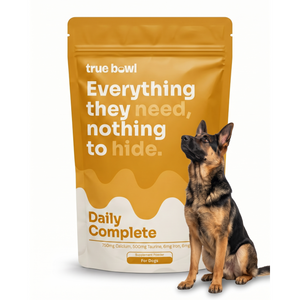
Bridging these micronutrient deficits requires exact, transparent dosing rather than guesswork. To solve this, Daily Complete was formulated specifically to complement home-prepared Indian dog meals.
Instead of hiding behind unmeasured "wellness" blends, Daily Complete discloses every active ingredient with precise metric weights. Formulated as a daily powder that mixes directly into fresh food, a single standard 5 g scoop (for a 10–20 kg dog) provides:
- 750 mg Calcium: Directly corrects the 688 mg gap and restores the proper 1:1 to 1.4:1 Ca:P ratio.
- 500 mg Taurine: Provides full cardiac and amino acid support.
- 6 mg Zinc & 6 mg Iron: Replaces bound trace minerals to support skin health and blood oxygenation.
- 1,500 IU Vitamin A & 112 IU Vitamin D3: Fully covers daily fat-soluble vitamin requirements.
- 450 IU Iodine: Supports healthy thyroid function.
Daily Dosing Protocol
Daily Complete uses a clear, scoop-based protocol tailored to your dog's weight:
- Less than 10 kg: ½ scoop (2.5 g powder)
- 10–20 kg: 1 scoop (5 g powder)
- 20–30 kg: 2 scoops (10 g powder)
- More than 30 kg: 3 scoops (15 g powder)
Important Safety Restriction: Puppies under 12 months of age (and large-breed puppies under 18 months) must not receive calcium supplementation like Daily Complete. Young, growing skeletons regulate calcium absorption differently, and over-supplementation during growth can cause permanent skeletal deformities.
---
FAQ
Can I rely on commercial kibble instead of home-cooked food to avoid these gaps?
Commercial kibbles are formulated to meet baseline nutritional requirements, but many dog parents prefer feeding fresh, whole food free from heavy processing. Using a target powder supplement like Daily Complete allows you to keep feeding fresh, home-prepared meals while ensuring your dog receives exact, balanced micronutrition.
How should I mix Daily Complete into my dog's meals?
Daily Complete is an unflavored or lightly palatable powder designed to be mixed directly into warm or room-temperature food once per day. Avoid heating or cooking the powder directly, as extreme heat can degrade delicate vitamins.
Why shouldn't puppies under 12 months be given calcium supplements?
Puppies cannot naturally limit excess calcium absorption in the gut until their metabolic pathways mature. Giving extra calcium to a growing puppy can cause accelerated, uneven bone growth, leading to severe joint and structural issues. Puppies should receive dedicated puppy formulations under veterinary oversight.
Related reading
- Is Chicken and Rice Enough for Dogs Long-Term?
- The Calcium Phosphorus Ratio in Dog Food Explained
- What Is Rubber Jaw Syndrome in Dogs? Causes and Prevention