




For a 15 kg medium adult dog, the National Research Council (NRC) recommended daily allowance for calcium is 750 mg. However, a typical Indian home-prepared meal of chicken, rice, paneer, or roti delivers only around 62 mg of calcium—leaving a massive 688 mg daily deficit.
Veterinary nutrition research shows that 84% of home-prepared dog diets are deficient in calcium, and 94% are nutritionally incomplete overall against National Research Council (NRC) standards. Without adequate daily calcium, a dog's body is forced to pull the mineral directly from its bones to maintain stable blood levels, quietly weakening its skeletal structure over time.
Bridging this gap requires understanding your dog’s weight-based requirement and knowing how to supplement calcium safely without disrupting other critical nutrient ratios.
Daily Calcium Requirements by Dog Weight

Calcium requirements scale directly with body weight and life stage. For adult dogs, the National Research Council establishes recommended daily allowances to ensure optimal bone density, nerve signaling, and muscle contraction.
Because plain muscle meat and grains are naturally very low in calcium, home-cooked diets consistently fall short regardless of the dog's size.
| Dog Weight | NRC Daily Calcium Target | Estimated Calcium in Home Diet | Daily Calcium Gap | Daily Complete Serving |
|---|---|---|---|---|
| Less than 10 kg | ~250–500 mg | ~20–40 mg | ~230–460 mg | ½ scoop (2.5 g) |
| 10–20 kg (e.g. 15 kg) | 750 mg | ~62 mg | 688 mg | 1 scoop (5 g) |
| 20–30 kg | 1,000–1,500 mg | ~80–120 mg | 920–1,380 mg | 2 scoops (10 g) |
| More than 30 kg | 1,500–2,250+ mg | ~130–180 mg | 1,370–2,070+ mg | 3 scoops (15 g) |
Note: True Bowl Daily Complete is formulated assuming that roughly 5% of a dog's daily calcium intake comes from home food, ensuring full coverage without crossing safe upper limits.
The Hidden Danger in Home Diets: Ca:P Inversion
The main issue with home-cooked dog food isn't just a lack of calcium—it is an inverted calcium-to-phosphorus (Ca:P) ratio. Dogs require a strict calcium-to-phosphorus ratio between 1:1 and 1.4:1 for structural stability and kidney health.
Meat, poultry, and grains are high in phosphorus but extremely low in calcium. For instance, plain chicken breast has a severely skewed Ca:P ratio of approximately 1:16. When fed over months or years without calcium fortification:
- Nutritional Secondary Hyperparathyroidism: The parathyroid gland detects low calcium levels in the bloodstream and releases hormones that pull calcium directly out of the skeleton to compensate.
- Phytate Interference: Grains like rice and wheat roti contain phytates, which bind to dietary minerals like zinc and calcium, reducing their intestinal absorption even further.
Why Adding an Egg Doesn't Fix the Gap
Many pet parents assume adding a boiled egg to their dog's meal solves nutritional deficits. However, one boiled egg contributes only about 27 mg of elemental calcium. For a 15 kg dog needing 750 mg daily, adding an egg still leaves the bowl roughly 660 mg short.
How to Replenish Calcium Safely
Supplementing calcium is not as simple as adding raw bone meal or crushed eggshells to food. Uncontrolled calcium administration can disrupt the absorption of other key minerals like zinc and iron, or strain kidney function.
Safety Warning: Puppies Under 12 Months
Excess calcium is highly hazardous during growth phases. Puppies under 12 months (and large-breed puppies up to 18 months, such as Labradors, German Shepherds, and Golden Retrievers) must never be given calcium supplements. Over-supplementation during rapid skeletal growth can cause severe joint deformities, osteochondrosis, and hip dysplasia.
Balanced Daily Fortification
For adult dogs, calcium supplementation should be paired with precise quantities of trace minerals and amino acids to maintain complete metabolic balance.
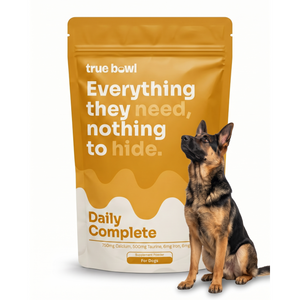
True Bowl Daily Complete delivers 750 mg of elemental calcium per 5 g scoop, intentionally formulated without added excess phosphorus so it corrects the skewed Ca:P ratio of home-cooked food. Combined with essential amino acids like taurine and vital trace minerals like iron and zinc, it fills daily nutritional gaps cleanly and transparently.
FAQ
Can I give my dog calcium tablets made for humans?
No. Human calcium supplements are formulated for human body weights and human digestive systems, often containing dosages that are far too high for dogs. They also lack the balanced amino acid and trace mineral profile required to maintain a proper calcium-to-phosphorus ratio in a canine diet.
Does feeding curd or milk supply enough calcium for my dog?
No. While dairy products contain calcium, many dogs lack sufficient lactase enzymes to digest dairy properly, leading to gastrointestinal distress. Furthermore, the volume of milk or curd required to meet a medium dog's 750 mg daily target would deliver excessive fat and calories.
What are the signs of long-term calcium deficiency in adult dogs?
In adult dogs, chronic calcium deficiency leads to weakened bones, joint stiffness, muscle tremors, lethargy, and brittle teeth. Because the body draws calcium from bones to protect heart and muscle function, bone loss often progresses silently before physical symptoms become obvious.
Related reading
- Home-Cooked Dog Food Missing Nutrients: The Hidden Gaps Explained
- Is Chicken and Rice Enough for Dogs Long-Term?
- Zinc Deficiency in Dogs in India: Causes, Symptoms, and Solutions